
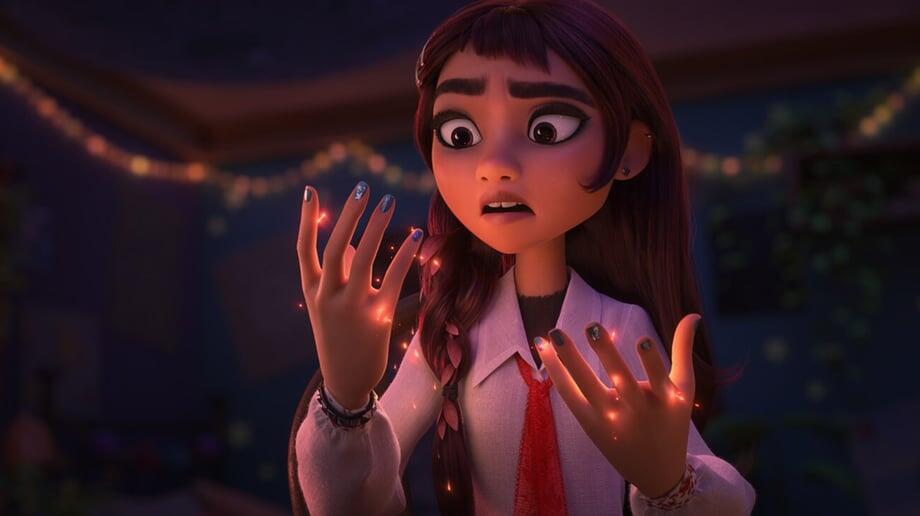
Disney has apparently decided that what children’s entertainment really needs is a little more witchcraft.
The company’s latest animated offering, Hexed, arrives in theaters November 25, promising audiences a whimsical coming-of-age adventure in a world of witches, spells, magical abilities, and supernatural self-discovery. And if the film’s promotional materials are any indication, Disney is no longer particularly interested in keeping its fascination with the occult confined to the occasional villain or Halloween special.
The story follows Billie, an unconventional teenage girl who discovers she possesses magical abilities and is transported into Hexe, an entire realm populated by witches and wizards. There, alongside her mother, she uncovers family secrets and discovers her place in this magical society. The filmmakers describe the story as an allegory for discovering one’s unique potential and learning how to use it for good or evil.
Which sounds lovely, until you consider what exactly that potential entails.
Disney appears to have gone all-in on presenting witchcraft not merely as a fictional plot device, but as an attractive, empowering part of a young girl’s identity. The supernatural world is colorful, inviting, and full of quirky characters. The protagonist isn’t a hero fighting against dark forces or resisting temptation. She’s a young witch discovering her powers, finding her community, and embracing what makes her special.
In other words, witchcraft is the superpower.
There’s an important distinction here that seems increasingly lost in contemporary entertainment: portraying evil in fiction is not the same thing as celebrating it. Christian storytelling has a long tradition of depicting supernatural evil, temptation, and spiritual warfare. Tolkien’s Middle-earth is filled with wizards, enchantments, and dark powers, but its moral universe is unmistakably grounded in the distinction between good and evil. The presence of magic in a story isn’t automatically an endorsement of the occult.
We introduce magic in The Adventures of Ziggy Wigglefuzz from the Deadly Sins and Heavenly Virtues series, but in all its allure, we were careful to show the dark side and there’s a price for engaging in it.

But Hexed seems to be approaching the subject from an entirely different direction. Rather than treating witchcraft as something spiritually dangerous, the film appears to sanitize and romanticize it, presenting the occult as an avenue for personal empowerment and self-discovery.
And that is precisely where Christian parents should take notice.
Scripture is hardly ambiguous about the subject. Deuteronomy 18:10-12 explicitly warns against sorcery, divination, and the practice of magic. The prohibition isn’t based on an inability to appreciate fantasy or imagination. It reflects a deeper understanding that human beings are not meant to seek supernatural power apart from God.
Of course, Disney isn’t making a theological documentary, and nobody should expect every animated movie to deliver a catechism lesson. But children’s entertainment inevitably communicates a moral vision of the world. It teaches children what is admirable, what is desirable, what is normal, and what is worth aspiring to.
When a company repeatedly packages occult imagery in appealing, child-friendly stories, it risks making something that Christianity has traditionally warned against seem harmless, fashionable, and even aspirational.
The concern isn’t that children will watch Hexed and immediately start practicing witchcraft. It’s that the boundaries between fantasy and spiritual reality become increasingly blurred, particularly for younger viewers who haven’t yet developed the judgment to distinguish between the two.
Disney’s defenders will undoubtedly point out that the film has good witches and bad witches, and that its ultimate message concerns using one’s abilities responsibly. But that distinction doesn’t really address the underlying concern. The question isn’t simply whether witches can be good or bad within the fictional universe of Hexe. It’s whether witchcraft itself should be presented as an attractive vehicle for personal fulfillment in the first place.
There is also something particularly ironic about a company whose cultural legacy was built on stories of enchanted kingdoms, fairy godmothers, and happily-ever-afters now leaning so heavily into the aesthetics of the occult. Once upon a time, magic was often a narrative device. With Hexed, it appears to be the point.
Christian parents don’t need to panic, and they certainly don’t need to outsource their children’s moral education to Disney. But neither should they feel obligated to accept every new offering from the entertainment giant simply because it comes wrapped in beautiful animation, catchy music, and a PG rating.
Not everything colorful is innocent, and not everything marketed as empowerment is worth embracing.
Disney may think it’s just making another magical adventure. Christian parents might reasonably see something else: a familiar cultural trend in which the occult is repackaged for children, stripped of its spiritual implications, and sold as entertainment.
The question isn’t whether Disney can make witchcraft look enchanting. Clearly, it can.
The question is whether that’s something we should want our children enchanted by.